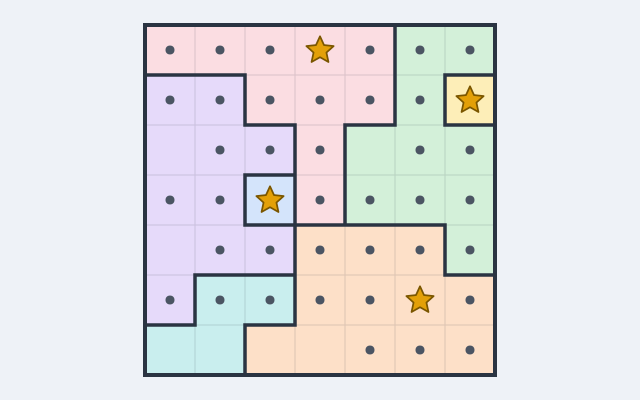
Star Battle is a grid divided into coloured regions. You place stars so that every row, every column and every region has exactly one, and no two stars touch, not even at a corner. The rules fit in a sentence, but the puzzles reward careful logic.
Every puzzle in Star Battle has exactly one solution, from 6 × 6 up to 9 × 9, so there is always a reason for the next star. These are the reasons to look for.
Dots are half the game
Most of solving Star Battle is ruling squares out. Mark every square that cannot hold a star with a dot. Each star you place rules out its whole row, its whole column, its region and the eight squares around it.
Aback Games shows a faint dot on squares your stars have already ruled out, so you can focus on the squares that are really still open.
Start with the smallest regions
A region of one square is a star. A region of two or three squares leaves very few choices, and even when you cannot tell which square it is, you can often rule out what all the choices have in common.
For example, if a small region sits in two squares side by side, its star is in that row whichever square it is. Every other square in that row gets a dot.
Regions trapped in a row or column
If every open square of a region lies in one row, that row’s single star belongs to the region. Dot every square of the row outside the region. The same works for columns, and it is often the first deduction on a new puzzle.
Turn it around too: if a row’s open squares all belong to one region, the region’s star is in that row, and every other square of the region can be dotted.
The 2 × 2 rule
Stars cannot touch, even diagonally, so any 2 × 2 block of squares holds at most one star.
A region whose open squares all fit inside one 2 × 2 block has its star somewhere in that block. Any square outside the region that touches every one of those open squares would touch the star wherever it goes, so dot it. When only two or three squares are open, there are usually several squares like that.
Count regions across several rows
Suppose two regions lie entirely inside the same two rows. Each region needs a star, and those two rows only have two stars between them. So the two rows’ stars both belong to those regions, and every other square in the two rows can be dotted.
The idea scales: if three regions fit inside three rows, those rows are theirs. It works with columns, and in reverse: if two rows are completely covered by squares of just two regions, those regions’ stars are in those rows and nowhere else.
Counting is the technique that cracks most Hard and Expert puzzles. When you are stuck, look at each pair of neighbouring rows and columns and ask which regions fit inside them.
Try a star, then look for trouble
When a region has two open squares left, imagine a star in one of them and follow the consequences for a few steps. If it would leave another region with nowhere to go, the star belongs in the other square. This is still logic: you are proving one choice impossible, not guessing.
Questions
What are the rules of Star Battle?
Place stars so that every row, column and region has exactly one, and no two stars touch each other, including diagonally.
Does every Star Battle puzzle have one solution?
Every puzzle on Aback Games is generated and then checked by a solver to have exactly one solution, so it can always be solved by logic.
What do the dots mean?
A dot marks a square that cannot hold a star. Placing them is how you narrow down where each star must go.