
Strategy
FreeCell strategy: plan the deal, keep the cells free
FreeCell is nearly all skill. How to read a deal, why empty columns are worth more than free cells, and how many cards you can move at once.
3 min read
The solitaire where every card is face up. Use four free cells to untangle eight columns and build the suits from ace to king.
Click a card to send it where it fits, or drag it. Safe cards go up to the foundations by themselves. Keys: arrows choose a pile, Enter picks up and drops, U undoes.Tap a card to send it where it fits, or drag it. Safe cards go up to the foundations by themselves.
Use Left and Right to move between piles, and Up and Down to choose how many cards to take from a column. Enter picks up cards and Enter on another pile puts them down. A sends the chosen card where it fits. U undoes, H shows a hint and P pauses.
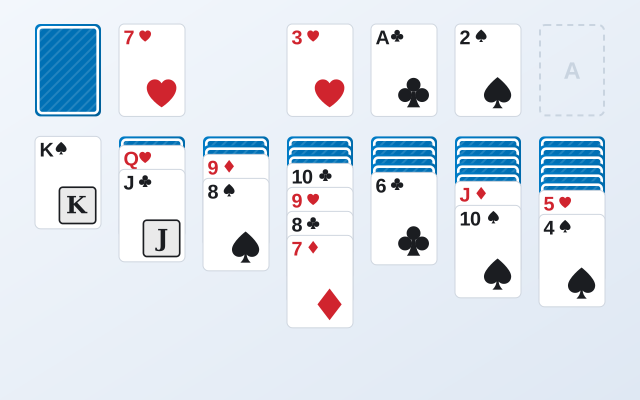
FreeCell is a solitaire card game where luck plays almost no part. All 52 cards are dealt face up into eight columns, so you can see everything from the start and plan your moves.
Four free cells give you somewhere to park single cards while you dig out the aces. Nearly every deal can be solved, so a lost game usually means there was a better line to find. Undo as much as you like and try again.
| Move a card where it fits | Click it (or drag it to a pile) |
|---|---|
| Choose a pile | Left and Right arrows |
| Choose how many cards to take | Up and Down arrows |
| Pick up and put down | Enter or Space, then Enter on the new pile |
| Undo / hint | U (or Ctrl+Z) / H |
| Pause / sound | P / M |
| Move a card where it fits | Tap it |
|---|---|
| Move a card somewhere else | Drag it to the pile you want |
| Undo, hint or new game | The buttons above the table |
All 52 cards are dealt face up into eight columns: four of seven cards and four of six.
Each free cell holds one card. Any card at the bottom of a column can go into an empty free cell, and a card in a free cell can be played to a column or a foundation.
Build columns down in alternating colours, such as a black 9 on a red 10. Any card can go into an empty column.
Strictly, cards move one at a time. As a shortcut you can move a whole run at once if you could do it card by card using free cells and empty columns: up to (free cells + 1) × 2 to the power of the number of empty columns. Moving into an empty column counts one empty column fewer.
Foundations build up by suit from ace to king. Aces and twos go up automatically, as does any card whose opposite-colour cards one rank lower are already on the foundations, because nothing could still need it.
Classic FreeCell has four free cells. Choose three or two for a tougher game; fewer cells also means fewer cards can move together.
Almost. Studies of large numbers of FreeCell deals have found only a tiny fraction that cannot be solved with four free cells, so you should assume a solution exists. With three or two free cells, more deals become impossible.
The number of cards you can move at once depends on your empty free cells and columns, because a multi-card move is a shortcut for moving them one at a time.
Cards are played up automatically once no other card could ever need them, the same convenience most FreeCell games offer. You can still undo it.
In Klondike Solitaire many cards start face down and you draw from a stock, so luck matters. In FreeCell everything is face up from the start, so it is almost entirely skill.
No. Your game, moves and time are saved in this browser as you play, and continue when you come back on the same device.
Strategy
FreeCell is nearly all skill. How to read a deal, why empty columns are worth more than free cells, and how many cards you can move at once.
3 min read
Strategy
Practical Klondike tips: where to look first, why an empty column is only useful with a king, when to hold cards back from the foundations, and how Draw 3 changes things.
3 min read
Strategy
How to approach Spider Solitaire at every suit setting: building in suit, making and keeping empty columns, and timing the deals from the stock.
2 min read
Card
Classic Klondike Solitaire. Build four suits from ace to king, with Draw 1 or Draw 3, unlimited passes, undo and hints.
Card
The two-deck solitaire. Arrange ten columns into full suits from king to ace, with 1, 2 or 4 suits to choose from.