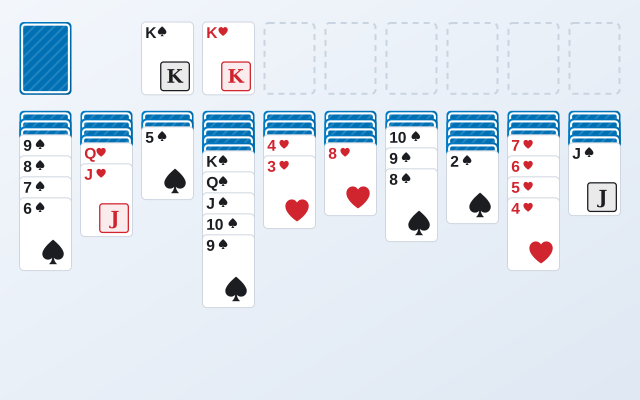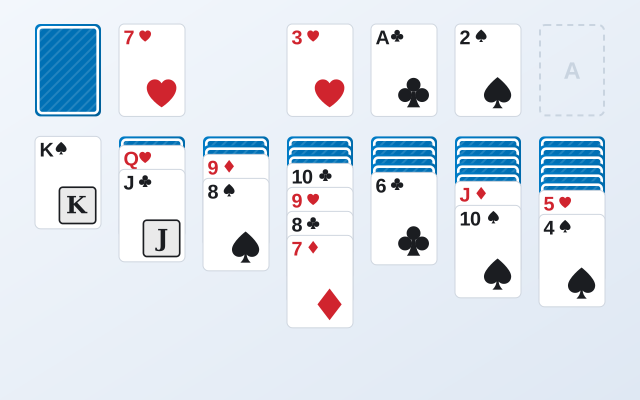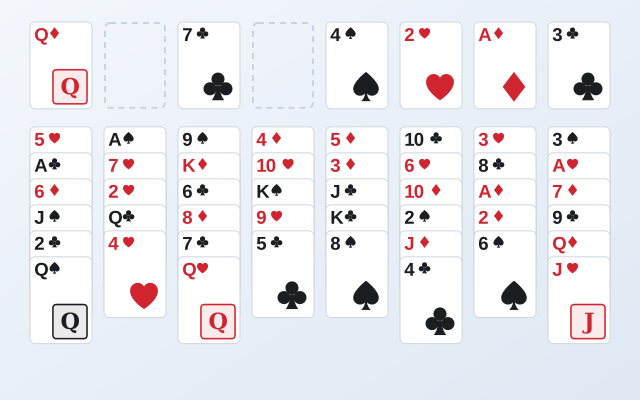
Spider Solitaire uses two decks, ten columns and a stock that deals a new card onto every column. You win by building eight complete runs from king to ace in one suit. One suit is relaxing, four suits is one of the hardest solitaires there is, and the same habits help at every level.
Try them in Spider Solitaire, which lets you pick 1, 2 or 4 suits.
Build in suit whenever you can
Any card can go on a card one rank higher, whatever the suit, but only a run in a single suit can move as a group. A 7 of hearts on an 8 of spades is a legal move that leaves you stuck: the pair can never move together.
When you have a choice, always put a card on one of its own suit. When you have to mix suits, do it at the bottom of a column where you will not need to move the run again soon.
Empty columns are your best tool
An empty column can take any card, which lets you reorganise mixed runs and swap cards between columns. Most won games of two- and four-suit Spider come from making an empty column and using it well.
Columns with the fewest face-down cards are the quickest to clear. Turn over their hidden cards first.
Time the deals from the stock
The stock deals one card onto each of the ten columns, five times in all. Each deal covers every column, which can bury the runs you are building.
Make every useful move first, especially moves that turn over face-down cards or bring runs into suit. Deal only when you are stuck. You cannot deal while a column is empty, so put something in every gap first, ideally a card you are happy to have covered.
Kings and long runs
Kings can only go into empty columns, so a king buried in a column is costly. Placing a king in an empty column is worth it when you can build a long run in its suit beneath it, because a column headed by a king never needs to move again.
One, two or four suits
- 1 suit: every card is a spade, so every run you build can move and be completed. Focus on speed and keeping columns open.
- 2 suits: spades and hearts. Mixed runs are common; untangle them using empty columns before they grow long.
- 4 suits: expect to mix suits. Be patient, use undo to test ideas, and keep at least one column clear for as long as you can.
Questions
Why can I not deal from the stock?
In Spider Solitaire you cannot deal while any column is empty. Move a card into each empty column first, then deal.
Which Spider Solitaire is the easiest?
One suit. Every card is a spade, so every run you build can be moved and completed. Two suits is a good next step before four.
What happens when I complete a run?
A full run from king to ace in one suit is removed from the table automatically. Remove all eight to win.